Saturday, April 18, 2009
One man's rubbish is another man's goldmine: Making charcoal briquettes and saving trees in the Rift Valley
The Rift Valley produces 2400 tons of waste every day. This waste is choking rural and urban centers, and most of it is discarded at undesignated dumpsites which include rivers and roadsides, among other areas.
OTEPIC has devised a "magic dome" that transforms useless waste into a new object of function and art. Like compost, this is another way in which we apply technique to reap benefits from waste.
OTEPIC-trained men and women collect soot remains from charcoal cooking fires, carrying the stuff on their backs. These "useless" black dust charcoal fragments remain after people have used or sold their charcoal.
Then the collectors mold the fragments into balls of 250 grams each (about 1/2 pound) with corn cobs at the core of each black orb. The balls are left in the sun for few days to dry. The corn cob improves combustion of the mold which is used as a charcoal briquette. This practice encourages recycling, creates a use for solid waste and reduces deforestation.
Sunday, April 12, 2009
OTEPIC guides Kenyan community in growing its gardens organically and using compost instead of synthetic fertilizer
OTEPIC and community members applied compost to the garden beds. Because our rain patterns are so unpredictable, we are waiting for rain before we put seed in the ground.
Our nursery seedlings are doing very well, and so far we have used only botanical extracts to control pests and diseases. Most of our local farmers want to know about varieties of good, "short season" seeds because we have food shortages in our country, Kenya.
Many local farmers are eager to learn how to make compost because they don’t want to depend again on synthetic fertilizer, which is expensive and harmful to our environment.
Guest posting by Eric Ambani, OTEPIC Chairman
Sunday, April 5, 2009
Nurturing food and eating in an organic way has health benefits

The sages say that there are scents from childhood so strongly rooted in your soul that decades later a whiff of that aroma immediately takes you back ….. For me the most profound and provocative scent is that of "boiled food." In my internship at Ecology Action in California, we decided to cook our meals entirely without oils and sugars. We sprinkled seeds like sunflowers and groundnuts on vegetables and other dishes. This provided the variety to enjoy our simple grain fare.
There were no complaints--everyone enjoyed the wonderfully appealing lightness of food prepared this way. It seemed a magical, yet disciplined experience for me because, before I went there, I felt that sugar and oil were "must have" ingredients to make food palatable.
This experience taught me that you can prepare food without oil with a minimum of fuss and great taste. With soup it's even easier. Cooking doesn’t require a lot of fancy additives like oil and sugar. It only requires simple, appetizing ingredients.
The culinary customs of our great grandparents omitted unnecessary oil and sugar. This type of cooking prevents diseases like arteriosclerosis, heart attack, and stroke which are precipitated by high fat in blood. Planning ahead to a future of robust good health for young and old people, we have to return to this type of cooking. For example, a product such as margarine contains polyunsaturated vegetable oil made from a hydrogenation process which creates an immune-damaging synthetic fat that elevates blood cholesterol.
Sugars can be used in small amounts for “flavor” but in large amounts, lead to obesity, hypoglycemia, tooth decay, loose bones, male impotence, weakened mind, loss of memory and laziness. The sweetness of food doesn’t depend on the amount of oil or sugar you add; it depends on the way you nurture the food. Nurturing is the process by which all things develop, and food can become a force for healing and harmony.
Thursday, March 19, 2009
Fencing land for our demonstration gardens in Mitume Village, Kitale in Rift Valley Province
I trust that buying the land, which represented a great leap of faith, will be rewarded. Blessed are the growers and sowers willing to thrive in the torrent of the times. We embrace with gratitude the serene ferocity of this journey, witnessing abundance explode out of the emerging world.
Monday, March 16, 2009
Kenyan farmers leverage their bargaining position through solar drying of fruits and vegetables
Last week OTEPIC trained farming group leaders how to dry fruit and vegetables using a solar dryer. Because they cannot store or preserve their surplus products, farmers often sell at very low prices during the harvest season. By using solar dryers, they will be able to preserve their food for future use, hence, enhancing food security and offering the potential to sell it later at higher prices.
I demonstrated how to dry bananas and how to prepare vegetables for drying. We dried carrots, pumpkin, tomatoes, pineapple, vegetables and mangos.
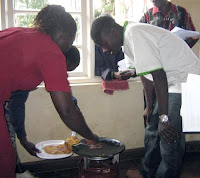
Once the food was prepared, we put it into the solar dryer.
Wednesday, March 4, 2009
Addressing Kenya's food crisis on a community level

My country Kenya is in crisis with food and fuel prices soaring and people starving. Through OTEPIC, I hope to bring low-water, organic techniques to my community where traditional approaches to producing food have been lost or are no longer possible. I believe that agriculture can have such profound effects on the environment, human health, and the social order, it is a critical part of any movement toward sustainability. I am looking for financial support for our community demonstration gardens. If you would like to help with our project, please contact me.
Here is a picture of me in the summer of 2008. I traveled from my small village in Kenya to the USA and learned about biointensive farming through my studies and work at the Ecology Action Center in Willits, CA.
I have spent my adult life learning about sustainability. In 2006-07, I worked with the Community Mobilization Against Poverty in Kitale, Kenya, increasing food security in the community by introducing women’s groups and small-scale farmers to farming practices that make efficient use of limited resources, require few external inputs, and protect natural resources, especially soil fertility, for future generations.
In 2003-'05, I studied biointensive farming at the Manor House Agricultural Centre in Kitale and I have worked with the Animal Care Initiative Network to teach humane care and protection of animals and encourage families to nurture their animals and thus themselves.
I hope some day to return to the US to get a degree in sustainable agriculture and then bring my skills and knowledge back to my community.
Tuesday, February 24, 2009
Rift Valley community commits to sustainable farming
Kenyan villagers smile because we have bought land to create organic demonstration gardens. We are excited about the future working with nature to enrich the land and the community.Our village elders, including our chief, witness the purchase of our land where we will establish our community demonstration gardens.

We count the money and sign the papers.

Already, we we are fencing the land, setting up the beds and starting to make beautiful compost!
Subscribe to:
Posts (Atom)